Simulation
Conway's Game of Life
A cellular simulation where simple rules generate complex, evolving patterns. Each cell lives, dies, or is born depending on its neighbors, requiring no player input after the start.
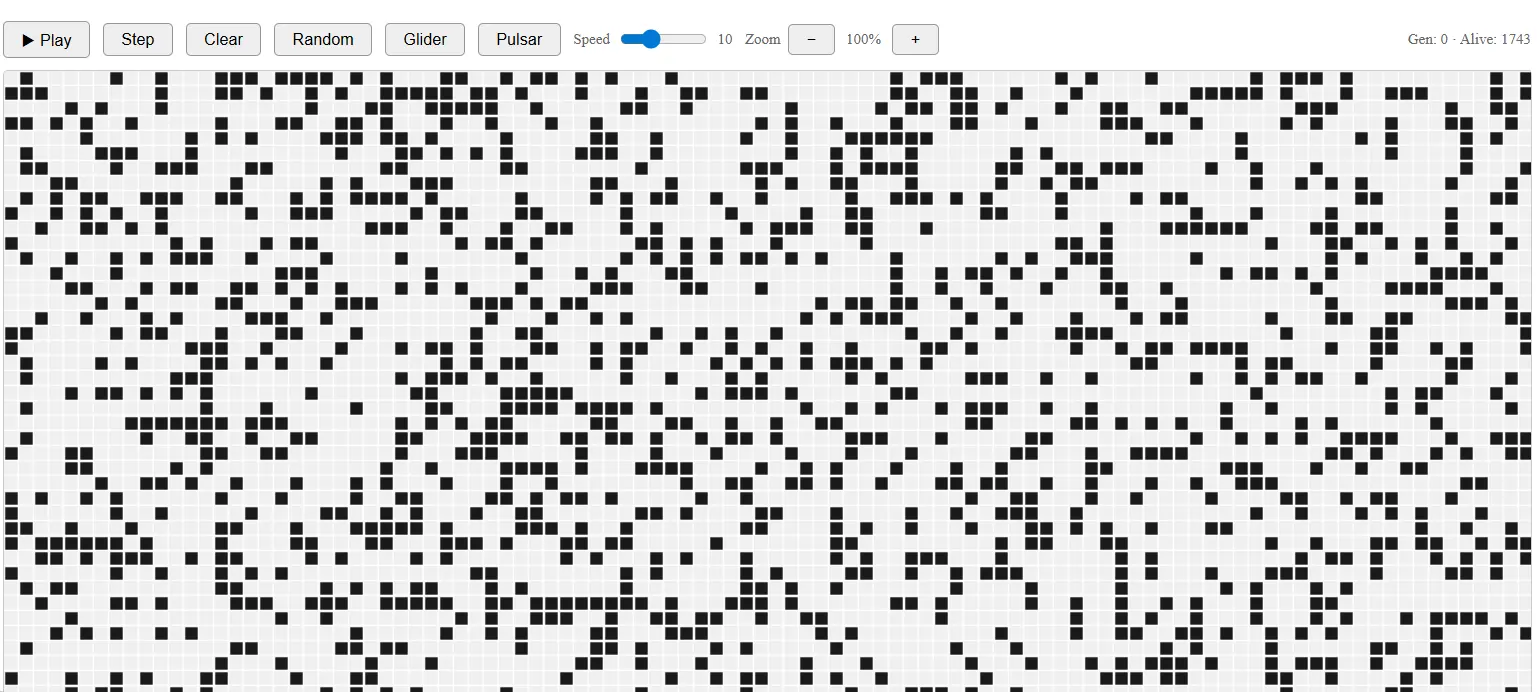
'Conway's Game of Life' is a mathematical simulation of a cellular automaton in which a two-dimensional grid of cells forms evolutionary new patterns according to simple rules.
Despite the simple basic logic, complex structures such as oscillators, gliders, or chaotic systems emerge.
The simulation is based on four basic rules:
-
Survival: A living cell only stays alive if it has at least 2 living neighbors.
-
Death by Isolation: If a living cell has too few neighbors, it dies.
-
Death by Overpopulation: If a living cell has more than 3 neighbors, it also dies.
-
Birth: A new cell is created in an empty field if exactly 3 neighbors are present.
Interface Controls:
-
Play / Pause: Starts or stops the simulation
-
Step: Advances the simulation by exactly one generational step
-
Clear: Clears the entire grid
-
Random: Fills the grid randomly with living cells
-
Glider / Pulsar: Inserts predefined patterns
-
Speed: Adjusts the speed of the simulation
-
Zoom: Enlarges or reduces the grid (100% = standard view)
-
Gen: Shows the current generation (development stage of the simulation)
-
Alive: Shows the number of currently living cells
Through this combination of control and automation, you can either experiment, analyze patterns, or simply watch how complex behavior emerges from simple rules.